Showing posts with label PC. Show all posts
Saturday, March 13, 2010
Lian Li PC-T1R Spider Case
I like it but two big drawbacks with this case. One, it's expensive, around $200 US or €150. And two, it only supports the tiny mini-ITX motherboard form factor. Comes in red or black.
via techPowerUp
Tuesday, March 9, 2010
Ubisoft's new DRM scheme under attack
In an attempt to thwart pirated copies of Assassin's Creed 2, Ubisoft employed DRM scheme that required any PC copy to access their Ubisoft server to check to see if it was a valid copy. Even if the game is played as a single player game. Well this made their DRM servers a target for a DDoS attack yesterday. Essentially shutting down all access to the PC versions of Assassin's Creed 2, including legitimate copies. D'oh.
via Ars Technica
Monday, March 1, 2010
Crytec's CryEngine 3 teaser video
Though my current computer can't play the original Crysis very well, so I'm not holding my breath.
via Destructoid
Thursday, February 25, 2010
Quake 3 running on a Droid/Android phone
Pretty neat as it is useless. Remember that anyone can play Quake Live (which is basically Quake 3) for free now on their PC or Mac. Props to id Software for making Quake 1, 2 and 3 all open source though.
via Android Bounty
Tuesday, February 23, 2010
Tiny PC
Kind of neat I think.
via Engadget
Monday, February 15, 2010
Command & Conquer: Tiberian Sun -- Hey it's free -- Impresions
So for the past few days I've been playing the newly free Command & Conquer: Tiberian Sun real-time strategy game. Initially released in 1999, its isometric graphics (2.5D) and low resolution certainly show how PC gaming has advanced visually in the last decade. I am struck that the game is well balanced. I learned quickly that you must employ most of your unit types each mission to avoid failure for each map. But I'm also struck by the fact that you almost certainly need to replay the mission multiple times and knowing what lies ahead is huge advantage. There is little to no dynamic changes when you replay a mission. Although the AI for the computer controlled units is fairly intelligent but not too intelligent to make for a frustrating experience.The game download is simply a compressed set of files in RAR format, use WinRAR to uncompress it. You just extract the EA Games folder in the compressed file to your "Program Files" directory and run the "tibsun_regadd.reg" in the "Command & Conquer The First Decade" folder. I was able to get it running with Windows 7 just fine with a further adjustments. You need to adjust the game's shortcut properties to run in Windows XP mode under the short cut's compatibility tab. I assume Windows Vista users will have to do the same thing.
The free download also comes with the Expansion Pack: Firestorm. You can play as either the NOD or GDI, each having their own units and abilities. As well as having their own campaign and poorly acted and written video cut scenes with James Earl Jones (the voice of Star Wars' Darth Vader!)
Hey, it's free right? So check it out and and tell me what you think of it?
Saturday, February 13, 2010
Free (legal) classic Command & Conquer games download available from EA
EA is giving away free older versions of the Command & Conquer RTS series.
C&C Tiberian Sun (released in 1999)
C&C Red Alert (released in 1996)
C&C Tiberian Dawn (released in 1995)
These downloads are the ISO images of the install disks, so see the install instructions for each game in the link. I use MagicDisk to mount ISO images as virtual CD-ROMs. If you are running in Vista or Windows 7, modify your shortcut to the game executable to run Windows XP mode, that's under your short cut's properties.
C&C Tiberian Sun (released in 1999)
C&C Red Alert (released in 1996)
C&C Tiberian Dawn (released in 1995)
These downloads are the ISO images of the install disks, so see the install instructions for each game in the link. I use MagicDisk to mount ISO images as virtual CD-ROMs. If you are running in Vista or Windows 7, modify your shortcut to the game executable to run Windows XP mode, that's under your short cut's properties.
Friday, February 5, 2010
Fearless Technology Predictions for the decade and 2020
I'm a bit late for post like this. It's been a whole month already of 2010, only 119 months to go until 2020! But I thought I'd offer my opinions about what the technology landscape will (might) look like in coming decade.
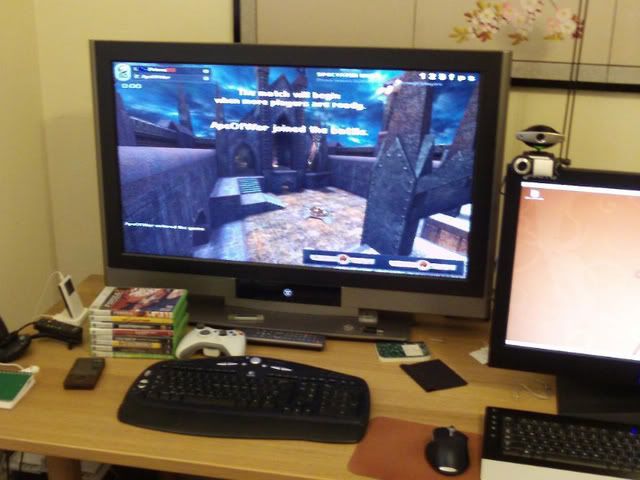
Technology of course, especially on the web, moves very fast and is hard if not impossible to predict more than a few years out. We are still only about 15 years into the mainstream use of the Internet. I've read that historically it takes 30 years for a brand new technology to fully integrate into a culture. If I look back to 2000, there is only one website I still use regularly in 2010 my.yahoo, or maybe two if I count craigslist which I use a litte). And of course, I've bought many new computers and mobile devices in that time. I now spend the majority of my computing time on a laptop instead of a desktop. My desktop has a large HDTV monitor connected to it instead of a small CRT display from ten years ago.
Web based social networking didn't really exist yet in 2000. Neither did video sharing, nor blogging even.
And it also needs to observed that many important killer apps in the 1980's and 90's didn't change that much last decade. Word processors and spreadsheet applications are quite similar to their 2000 versions. The web browser itself has only marginally improved in the last decade. My Windows desktop interface shows only minor changes beyond the window style and 64-bit functionality.
So here are my 9 fearless and maybe somewhat obvious predictions for 2020.
1.) WhiteFi -- This is new freed up bandwidth spectrum that allows much wider coverage for broadband wireless Internet connectivity. I believe most all computer devices will be connected wirelessly to the web at all times and your other owned devices, like smart phones, cameras, HDTVs. Wired connections will be largely only for electricity and charging.
2.) Beyond HDTV -- Much bigger is much better. 1080p video is nice but 4K format (4096×2304) is better for very large displays. I foresee a proliferation of inexpensive, large 80+ inch (2+ meter) displays by the end of this decade. This size of display will demand an much higher resolution to maintain a HD look.
3.) Television/Internet Integration -- Your video will all come through your broadband connection and your TV will have most PC functionality of course tailored to a living room environment. You are already seeing this become a standard for most Blu-ray players being able to play Hulu and YouTube videos. The Xbox 360 has Netflix streaming. I see this integration becoming virtually seamless and subscription based. With your smart phone being your TV remote control for complex interface interaction commands to your TV. Maybe even using voice commands for basic things.
4.) Video Proliferation -- Everything will have an high quality camera on it. This is almost already true for phones and laptops now. This goes hand in hand with all three previous prediction. Though I don't see video conferencing replacing most telephone conversations for two reasons. Proper eye contact is fundamentally difficult and off putting and people don't have to be presentable while on a traditional voice call.
5.) Cyber-Terrorism -- As the world's infrastructure is more ubiquitously tied to the Internet, the more ripe of a target it is to terrorists and organized crime. The current infrastructure is largely unprepared to guard against a coordinated attack to do damage to key pieces of infrastructure or a mass attack causing damage to user PCs.
6.) Internet Regulation/Censorship -- Since the web largely has and will become the dominate medium of communication, I think there will be a strong push to regulate and ultimately censor web usage. You already see this with China's great firewall. I think a cyber attack would make this much easier for governments to justify and corporate interests are keen on limiting user freedoms. This would include freedoms to subvert copyright protections or hurt government or corporate public opinion. This might create a system to reduce the opportunity for user anonymity on the web.
7.) Effects of Multi-core Computing -- With the proliferation many dozen or more multi-CPU cores in a single device has the potential to have a transformative effect on all aspects of user computer interaction. Possibly making robust speech recognition a primary method for human-computer interaction. Photo-real real-time render graphics and games become possible that combine with motion capture data taken real-time from the user's video cameras that steam directly into online MMO avatars as a possible example in 10 years.
8.) DNA/genetic Software -- With the acceleration of gene sequencing technologies, it will be common for all people have their entire genome sequenced in the coming decade. This will open the door for an explosion of genetic related applications from health, to heredity, to genetic genealogy maps. We are intensely interested in finding out things about ourselves and people we are close to, few things are as personal and hidden as our genomic information.
9.) Dynamic Social Networking -- Human beings of course love to socialize and the Internet enables the scope of our social nature to be wider than ever though possible. Maybe the biggest story in technology in the last decade was the proliferation of social networking based websites. Facebook, YouTube, Twitter, blogTV just to name a few. These networks are largely text and still image based. With the proliferation of video recording devices and constant Internet connectivity, I believe you could see a much richer and real-time feed of information generated by people in your social network. A website enriched by real-time video or recorded video updates is maybe only the tip. The only limitation is desire for personal privacy. But I think you are going to continue to see the desire yield some of that privacy because openness and intimacy is rewarded by attention from others. As our social networks expand, I think data mining will be desirable to connect to new people and collect the ever growing pieces of content generated by our social networks/friends. Sadly, it's maybe impossible to envision the shape of the next big thing in social networking but all forms of media (video, audio, text, portability, connectivity) are now in play on the web and ready to mix and evolve.
What are your fearless predictions for the next decade? I want to hear them. =)
Technology of course, especially on the web, moves very fast and is hard if not impossible to predict more than a few years out. We are still only about 15 years into the mainstream use of the Internet. I've read that historically it takes 30 years for a brand new technology to fully integrate into a culture. If I look back to 2000, there is only one website I still use regularly in 2010 my.yahoo, or maybe two if I count craigslist which I use a litte). And of course, I've bought many new computers and mobile devices in that time. I now spend the majority of my computing time on a laptop instead of a desktop. My desktop has a large HDTV monitor connected to it instead of a small CRT display from ten years ago.
Web based social networking didn't really exist yet in 2000. Neither did video sharing, nor blogging even.
And it also needs to observed that many important killer apps in the 1980's and 90's didn't change that much last decade. Word processors and spreadsheet applications are quite similar to their 2000 versions. The web browser itself has only marginally improved in the last decade. My Windows desktop interface shows only minor changes beyond the window style and 64-bit functionality.
So here are my 9 fearless and maybe somewhat obvious predictions for 2020.
1.) WhiteFi -- This is new freed up bandwidth spectrum that allows much wider coverage for broadband wireless Internet connectivity. I believe most all computer devices will be connected wirelessly to the web at all times and your other owned devices, like smart phones, cameras, HDTVs. Wired connections will be largely only for electricity and charging.
2.) Beyond HDTV -- Much bigger is much better. 1080p video is nice but 4K format (4096×2304) is better for very large displays. I foresee a proliferation of inexpensive, large 80+ inch (2+ meter) displays by the end of this decade. This size of display will demand an much higher resolution to maintain a HD look.
3.) Television/Internet Integration -- Your video will all come through your broadband connection and your TV will have most PC functionality of course tailored to a living room environment. You are already seeing this become a standard for most Blu-ray players being able to play Hulu and YouTube videos. The Xbox 360 has Netflix streaming. I see this integration becoming virtually seamless and subscription based. With your smart phone being your TV remote control for complex interface interaction commands to your TV. Maybe even using voice commands for basic things.
4.) Video Proliferation -- Everything will have an high quality camera on it. This is almost already true for phones and laptops now. This goes hand in hand with all three previous prediction. Though I don't see video conferencing replacing most telephone conversations for two reasons. Proper eye contact is fundamentally difficult and off putting and people don't have to be presentable while on a traditional voice call.
5.) Cyber-Terrorism -- As the world's infrastructure is more ubiquitously tied to the Internet, the more ripe of a target it is to terrorists and organized crime. The current infrastructure is largely unprepared to guard against a coordinated attack to do damage to key pieces of infrastructure or a mass attack causing damage to user PCs.
6.) Internet Regulation/Censorship -- Since the web largely has and will become the dominate medium of communication, I think there will be a strong push to regulate and ultimately censor web usage. You already see this with China's great firewall. I think a cyber attack would make this much easier for governments to justify and corporate interests are keen on limiting user freedoms. This would include freedoms to subvert copyright protections or hurt government or corporate public opinion. This might create a system to reduce the opportunity for user anonymity on the web.
7.) Effects of Multi-core Computing -- With the proliferation many dozen or more multi-CPU cores in a single device has the potential to have a transformative effect on all aspects of user computer interaction. Possibly making robust speech recognition a primary method for human-computer interaction. Photo-real real-time render graphics and games become possible that combine with motion capture data taken real-time from the user's video cameras that steam directly into online MMO avatars as a possible example in 10 years.
8.) DNA/genetic Software -- With the acceleration of gene sequencing technologies, it will be common for all people have their entire genome sequenced in the coming decade. This will open the door for an explosion of genetic related applications from health, to heredity, to genetic genealogy maps. We are intensely interested in finding out things about ourselves and people we are close to, few things are as personal and hidden as our genomic information.
9.) Dynamic Social Networking -- Human beings of course love to socialize and the Internet enables the scope of our social nature to be wider than ever though possible. Maybe the biggest story in technology in the last decade was the proliferation of social networking based websites. Facebook, YouTube, Twitter, blogTV just to name a few. These networks are largely text and still image based. With the proliferation of video recording devices and constant Internet connectivity, I believe you could see a much richer and real-time feed of information generated by people in your social network. A website enriched by real-time video or recorded video updates is maybe only the tip. The only limitation is desire for personal privacy. But I think you are going to continue to see the desire yield some of that privacy because openness and intimacy is rewarded by attention from others. As our social networks expand, I think data mining will be desirable to connect to new people and collect the ever growing pieces of content generated by our social networks/friends. Sadly, it's maybe impossible to envision the shape of the next big thing in social networking but all forms of media (video, audio, text, portability, connectivity) are now in play on the web and ready to mix and evolve.
What are your fearless predictions for the next decade? I want to hear them. =)
Monday, February 1, 2010
New Diablo III Screen shots
Blizzard released some brand new screen shots of it's upcoming sequel Diablo III. But don't get your hopes up too high because it's not scheduled for release until 2011, so in Blizzard speak more like 2012?
via Destructiod
Friday, January 8, 2010
Game Review: Quake Live
Quake Live is essentially a web browser based version of now ten year old Quake III: Arena by id Software. The game play consists entirely of first person shooter (FPS) deathmatch, capture the flag, a team deathmatch type games against other players connected to the same game server via an Internet connection. Matches can be against as little as one other player, to over a dozen other players simultaneously playing. Technically, Quake Live is still in beta but the game as a whole is finished thus in a fair state to review.
There are 4 key differences to Quake Live and Quake III: Arena:
This relatively simple game play puts a premium on your first person shooter skills, learning the strategy of each of the dozens of maps and your opponents' tendencies. This is where the Quake Live skill matching system is key. You earn a skill rating (1 being the worst to 5 being the best) for each game type. This is in theory will allow for more competitive and balanced matches and thus more fun. This skill rating is dynamic and will potentially change as you win or loss matches.
All match statistics can be reviewed by the player. Kills, deaths, weapon accuracy, wins and loss all can be viewed via the Quake Live website via your own profile page. Here is my profile as an example. Even global ratings are compiled and can be compared. This does add a fun way to compare your skills to others beyond in game match results. You can also watch other matches via a spectator mode that allows you to view the match from the view point of other players or from a flying 3rd person viewpoint. This is an excellent way to learn new tricks and tactics.
The game isn't without drawbacks however. Since the game play is so hard core, the learning curve for new players can be quite unforgiving. You can set up practice matches against AI opponents but that only goes so far in preparing you for games against experienced players, though it will help. Another problem is that there usually aren't enough new players to play against. id Software currently isn't doing enough promotion or advertising to draw in new players. So generally you are up against people of much better skills, mixed with a few newbies that usually end up as cannon fodder for the better players.
The ten year old graphics and sound are dated compared from to modern FPS games like Unreal Tournament 3. The character models are quite poor. Luckily the game moves at such a fast pace you really don't have time to dwell on it. The environments are again quite sparse and low detail. Since the game runs in a web browser (you can and will want to play in full screen mode), the performance is surprisingly poor compared to the standalone Quake III. Though any gaming PC or relatively new laptop should be able to play at reasonable frame rates. Though you will need a mouse. Playing with a track pad or game controller is out of the question.
Nerdphilia rating: 3.5 out of 5 stars
There are 4 key differences to Quake Live and Quake III: Arena:
- id Software hosts all the servers, no player hosted servers or player created mods or maps
- Servers are skill rated, in an attempt to match the opponents of similar skill levels
- Comprehensive match statistics are recorded for each player and their matches
- Quake Live is entirely free to download and play
This relatively simple game play puts a premium on your first person shooter skills, learning the strategy of each of the dozens of maps and your opponents' tendencies. This is where the Quake Live skill matching system is key. You earn a skill rating (1 being the worst to 5 being the best) for each game type. This is in theory will allow for more competitive and balanced matches and thus more fun. This skill rating is dynamic and will potentially change as you win or loss matches.
All match statistics can be reviewed by the player. Kills, deaths, weapon accuracy, wins and loss all can be viewed via the Quake Live website via your own profile page. Here is my profile as an example. Even global ratings are compiled and can be compared. This does add a fun way to compare your skills to others beyond in game match results. You can also watch other matches via a spectator mode that allows you to view the match from the view point of other players or from a flying 3rd person viewpoint. This is an excellent way to learn new tricks and tactics.
The game isn't without drawbacks however. Since the game play is so hard core, the learning curve for new players can be quite unforgiving. You can set up practice matches against AI opponents but that only goes so far in preparing you for games against experienced players, though it will help. Another problem is that there usually aren't enough new players to play against. id Software currently isn't doing enough promotion or advertising to draw in new players. So generally you are up against people of much better skills, mixed with a few newbies that usually end up as cannon fodder for the better players.
The ten year old graphics and sound are dated compared from to modern FPS games like Unreal Tournament 3. The character models are quite poor. Luckily the game moves at such a fast pace you really don't have time to dwell on it. The environments are again quite sparse and low detail. Since the game runs in a web browser (you can and will want to play in full screen mode), the performance is surprisingly poor compared to the standalone Quake III. Though any gaming PC or relatively new laptop should be able to play at reasonable frame rates. Though you will need a mouse. Playing with a track pad or game controller is out of the question.
Unofficial Quake Live Trailer
The verdict
Hits:
- Good weapon balance
- Good map design
- Nice web interface with match statistics
- PC, Mac and Linux supported
- Entirely free to play
Misses:
- Dated graphics
- No player supported servers or mods
- Not enough new players at the current moment
- Surprisingly high system requirements to achieve a desired 60+ frames per second
- Cumbersome advanced game client configuration system
Nerdphilia rating: 3.5 out of 5 stars
Friday, January 1, 2010
Game Review: Defense Grid
Defense Grid is simply the best tower defense genre game I have ever had the pleasure of playing. Even if you don’t like the genre you owe it to yourself to at least download the demo via Xbox Live or Steam for your PC.
What makes Defense Grid a great game is the simplicity yet subtle nuance of its core game design. You are given the task of preventing an army of mechanized bugs from stealing your base’s energy cores. You do this by selectively placing a variety of towers and turrets along the path the bugs take. Sometimes even influencing the path they will take to maximize your towers’ destructive capabilities.
Each tower type has its strength and weakness and you will find that you must and will want to employ them all in the right situation, place and time. For example, the cannon turrets do high direct damage at long range, while the laser turrets do more damage overtime. Machine gun turrets require line of sight but are cheap and effective. This to just name a few of dozens of types and upgrades you will have at the ready to employ.
The pure fun of playing the game is doing just this. The challenge starts out fairly easy but progressively requires understanding the nuances of each tower type and the interplay between the position you place them and the order you place them since your tower building resources are tight at the start of each level. The more bugs you destroy the more resources to build with you attain.
But take heart, the game utilizes a series of automatic check point save points as your progress through each level. So if you paint yourself into a corner, you can easily rollback a few minutes of progress and start anew at mid-level without having to restart from the beginning. This makes retrying different micro-strategies more fun than frustrating.
The invading bugs are also varied in their abilities and the patterns of waves they come at you. Some fly while others move quickly on the ground. Some are weak armored but attack in swarms. While still others generate shielding for large groups of their slow but well armored comrades.
The graphics are the best of any tower defense game I’ve seen. The battle effects and sounds are very satisfying. The environments are pristine and varied, from barren waste lands, to snowy mountainsides.
The verdict
Hits:
- Addictive game play
- Well balanced learning curve
- Solid environments and sound
- Inexpensive price: $10 or less via Steam or Xbox Live download
Misses:
- The invading bugs could be more varied
Nerdphilia rating: 4.5 out of 5 stars
Sunday, December 27, 2009
Game Review: Torchlight
Torchlight is Diablo 2.5 for the all the people waiting for the yet to be released Diablo 3. As the old saying goes, “Imitation is the sincerest form of flattery”. It shamelessly copies almost every game play element of Blizzard’s classic Diablo II released in 2000. One key shortcoming when comparing the two games is that Torchlight lacks any multiplayer component. It’s strictly a single player experience for your PC.
The verdict
Hits:
- A solid 3D graphics and good art and character design
- Decent story and voice acting in the few cut scenes
- Good replay value with the three different character classes:
- Destroyer – melee combat
- Alchemist – magic spell user
- Vanquisher – ranged projectile combat
- Inexpensive price: $20 or less via a Steam download
Misses:
- Does little to try to improve the action role-playing genre
- The Normal default difficulty doesn’t offer enough difficulty for most gamers thus making the game too trivially easy (I recommend the Hard difficulty)
- Your pet sidekick is largely inconsequential in combat for most the game and you have little control over its actions
- The path finding for the AI is surprisingly poor causing some frustration getting your pet to follow you around the dungeon properly
Nerdphilia Rating: 3.5 out of 5 stars
Subscribe to:
Posts (Atom)